Quantum Computing's Breakthrough: A New Era of Processing Power
Quantum computing has taken a monumental leap forward, with recent advancements showcasing the potential for quantum processors to outperform classical computers in specific tasks. This development marks a pivotal moment in the field, signaling a shift from theoretical possibilities to tangible results. The journey of quantum computing began with experiments that demonstrated its unique capabilities, setting the stage for future innovations.
The Foundations of Quantum Computing
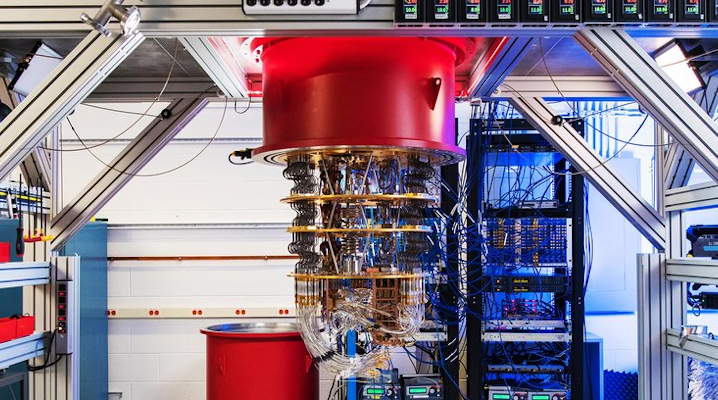
At the heart of quantum computing lies the qubit, a fundamental unit of quantum information. Unlike classical bits, which exist in a state of 0 or 1, qubits can be in multiple states simultaneously due to a phenomenon known as superposition. This allows quantum computers to process vast amounts of data at once, significantly increasing their computational power. Another key principle is entanglement, where qubits become interconnected, influencing each other's states instantaneously regardless of distance. These principles form the foundation upon which quantum algorithms are built.
Key Principles
- Qubits: The basic building blocks of quantum computing.
- Superposition: Enables qubits to exist in multiple states simultaneously.
- Entanglement: Links qubits together, allowing for coordinated computation.
- Quantum Interference: Facilitates the amplification of correct computational paths.
- Quantum Gates: Analogous to classical logic gates but operate on qubits using unitary operations.
Mathematical Underpinnings
Quantum computing relies heavily on mathematical concepts such as linear algebra and Hilbert spaces. These frameworks allow for the representation of quantum states and the manipulation of qubits through unitary transformations. Measurement theory also plays a crucial role, as outcomes are probabilistic, adding an element of unpredictability to quantum computations.
Quantum Algorithms and Their Impact
Several groundbreaking quantum algorithms have emerged, each offering unique advantages over classical counterparts. Shor’s Algorithm, for instance, enables polynomial-time factorization, posing a significant threat to classical encryption methods. Grover’s Algorithm provides a quadratic speedup for unstructured search problems, while the Quantum Fourier Transform serves as a core component in many quantum algorithms. These algorithms underscore the transformative potential of quantum computing across various domains.
Quantum Hardware Models
The evolution of quantum hardware has been instrumental in advancing the field. Superconducting circuits, trapped ions, and photonic systems are among the leading platforms for quantum computing. Each offers distinct advantages, such as fast operation speeds for superconducting circuits or high precision and stability for trapped ions. These developments are critical in overcoming practical challenges and enhancing the performance and scalability of quantum computers.
Recent Advancements in Quantum Computing
In 2019, Google made headlines by reporting the use of a 53-qubit processor to sample the output of a "random" quantum circuit. This experiment demonstrated the ability of quantum processors to outperform classical computers, albeit in a specific task. While the results were impressive, subsequent research has improved classical simulations, blurring the line between quantum and classical performance. Nevertheless, this milestone highlights the growing capabilities of quantum computing.
15 Groundbreaking Advancements
- Precise Control of Individual Qubits: Researchers at the University of Waterloo have developed methods to control individual barium ion qubits with unprecedented precision, enhancing the reliability and scalability of quantum computers.
- Quantum Supremacy Milestone: Google's claim of achieving "quantum supremacy" marked a historic moment, demonstrating the ability of quantum processors to perform tasks impractical for classical computers.
- Reliable Quantum Algorithm Execution: IBM's advancements in managing the unreliability of quantum computers are crucial for transitioning from experimental phases to real-world applications.
- Quantum Annealing for Optimization: This technique leverages quantum mechanics to solve optimization problems more efficiently, with applications in finance and logistics.
- Quantum Machine Learning: Combines quantum algorithms with machine learning to process large datasets at unprecedented speeds, promising breakthroughs in diagnostics and predictive analytics.
- Quantum Cryptography: Utilizes quantum mechanics to secure data transmission, offering theoretically unbreakable security through quantum key distribution (QKD).
- Quantum Simulation of Complex Systems: Enables the simulation of molecular interactions and chemical reactions with high precision, accelerating drug discovery and material innovation.
- Quantum Sensing and Metrology: Achieves measurements with unprecedented precision, applicable in navigation, geological exploration, and medical imaging.
- Quantum Internet and Communication: Aims to revolutionize secure communication through quantum entanglement, ensuring robust security in data transmission.
- Quantum Error Correction: Addresses the challenge of managing errors in quantum computing, essential for building reliable and scalable quantum systems.
- Quantum Programming Languages and Algorithms: Develop specialized tools to exploit the unique capabilities of quantum processors, translating theoretical potential into practical applications.
- Quantum Hardware Advancements: Significant progress in superconducting circuits, trapped ions, and photonic systems enhances the performance and scalability of quantum computers.
- Quantum Supremacy in Chemistry: Demonstrates the ability of quantum computers to simulate chemical processes, with implications for drug design and material science.
- Quantum Advantage in Optimization: Offers faster solutions to optimization problems, impacting industries such as logistics and finance.
- Quantum Supremacy in Factoring: Highlights the potential threat to current cryptographic techniques, necessitating the development of quantum-resistant cryptography.
Future Applications and Potential
The future of quantum computing holds immense promise across various fields. In medicine, it could revolutionize drug discovery and personalized treatment plans. Materials science may benefit from the ability to simulate complex molecular interactions, leading to the creation of advanced materials. Financial modeling could see significant improvements in risk assessment and portfolio management. Additionally, quantum computing has the potential to transform cryptography, making data transmission more secure.
Challenges and Considerations
Despite the exciting prospects, several challenges remain. Hardware stability and scalability are critical issues, as quantum systems are highly sensitive to their environment. Error correction techniques need further refinement to ensure reliable computations. Ethical implications, including the potential misuse of quantum technology, must also be addressed.
Conclusion
Quantum computing represents a revolutionary leap in processing power and efficiency, promising to transform industries from healthcare to cryptography. The advancements discussed here illustrate the breadth and depth of its potential impact. As researchers continue to overcome technological challenges, the future of quantum computing looks increasingly promising, poised to redefine what is possible within computing and beyond. With continued innovation and collaboration, the dream of practical quantum computing may soon become a reality.


Comments
Post a Comment